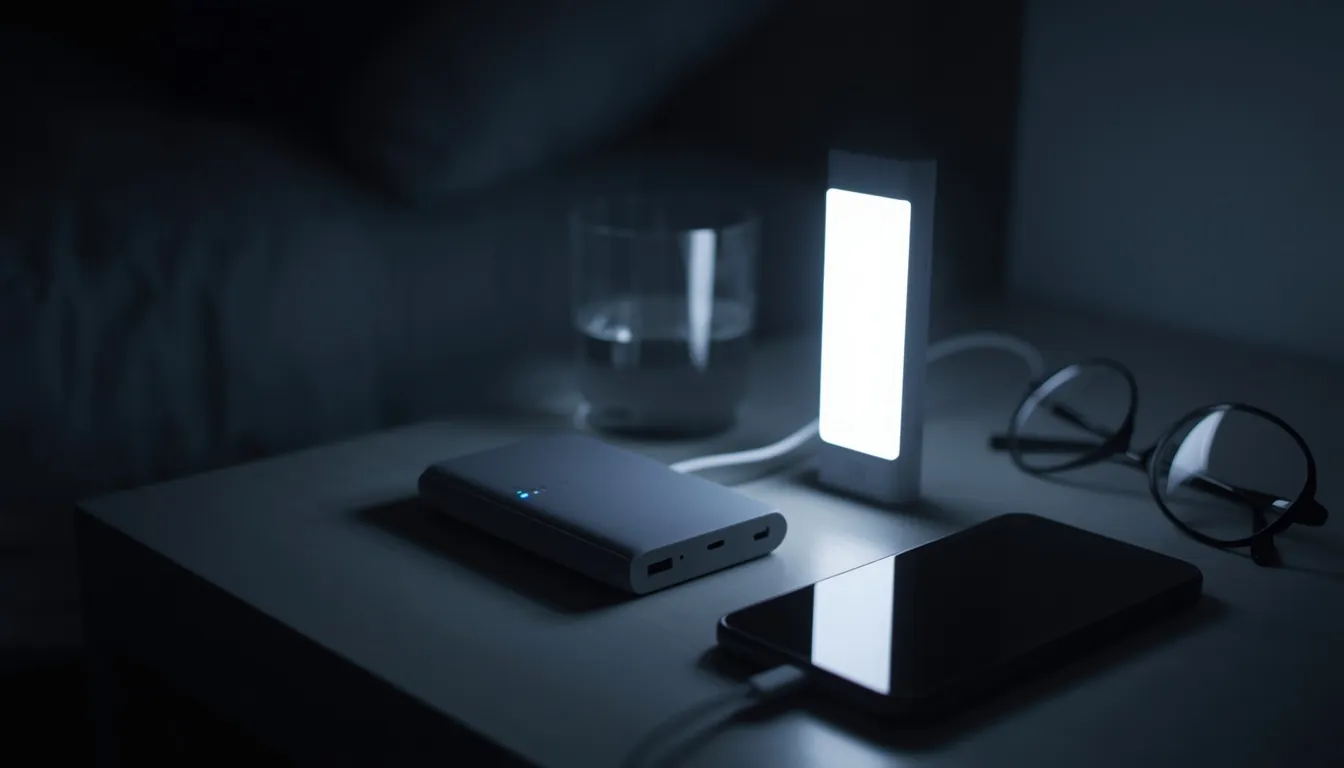
In a power cut your phone is your torch, your news, and your way to call for help. A charged power bank is the cheapest piece of insurance in any emergency kit. But the numbers on the box can be misleading, so here's how to choose one that will actually last.
How many charges will I get?
Power banks lose some energy converting and transferring power, so you get roughly 60–70% of the stated capacity. Most phones have a 3,000–5,000mAh battery.
| Power bank | Approx. full phone charges | Good for |
|---|---|---|
| 10,000mAh | 1.5–2 | One person, a day or two |
| 20,000mAh | 3–4 | One person for 3 days, or two people for a day or two |
| 25,000–27,000mAh | 4–5 | A couple or small family, or charging a laptop |
Rough guide only — it depends on your phone and how you use it.
Our recommendation by household
- Living alone: one 20,000mAh power bank.
- Couple: one 20,000mAh each, or a single 25,000mAh+ bank with two or more ports.
- Family or home worker: a laptop-capable power bank (65W+ USB-C), or step up to a portable power station for longer cuts.
- Grab bag or car: a slim 10,000mAh that's light enough to carry.
Features worth paying for
- USB-C Power Delivery (PD): charges modern phones much faster, so you can top up quickly if power comes back briefly.
- Two or more ports: charge two phones at once.
- A charge display: shows exactly how much is left — far better than four tiny lights.
- A built-in torch: handy, but not a replacement for a proper lantern.
- A reputable brand: very cheap unbranded banks often have much less capacity than they claim. Brands widely sold in the UK include Anker, INIU, Baseus and UGREEN — compare current models rather than buying on brand alone.
What about solar or wind-up power banks?
The small solar panel built into some power banks is only a trickle charger: it can take days of good sun to fill the battery. Hand cranks produce even less. They're fine as a last resort, but buy for battery capacity first. If you want solar, a separate folding solar panel is far more effective.
Keep it ready
- Charge it fully and store it at room temperature.
- Lithium batteries slowly lose charge: top it up every 3 months. An easy reminder is when the clocks change.
- Keep the right cables with it, such as USB-C and Lightning.
- Don't charge it under pillows or on a bed, and replace it if it swells or gets hot.
Good to know
If you fly, power banks over 100Wh (about 27,000mAh) usually need airline approval and must always go in hand luggage.
Some links in this guide go to Amazon UK. They're affiliate links: if you buy, we may earn a small commission at no extra cost to you.